
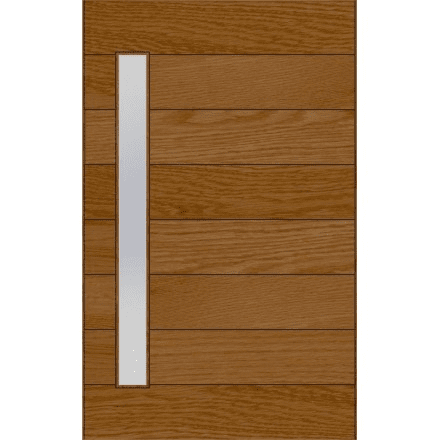
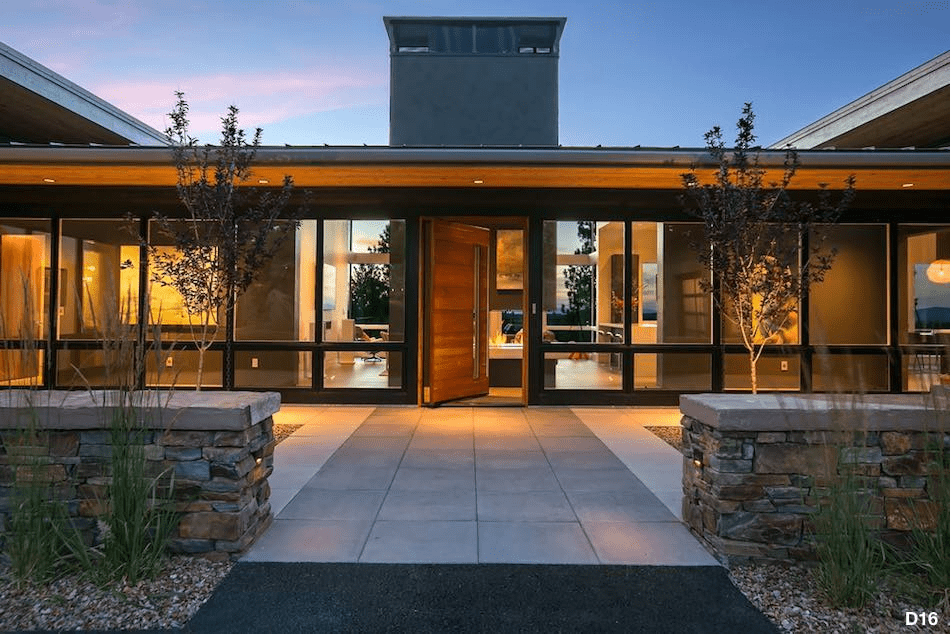
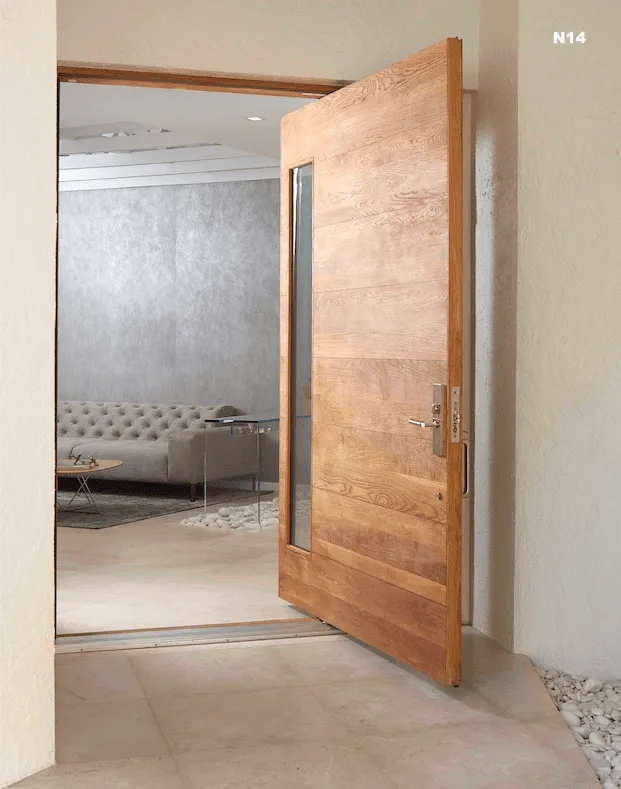
WHAT’S INCLUDED WITH YOUR ORDER
The purchase price includes both the door slab and jamb. The jamb is assembled and prepped during manufacturing, then disassembled for shipping. Unit comes with the pivot hardware already installed in both the slab and the jamb. Door ships stain ready (needs stain and clear-coat). Handle sold separately.LEAD TIMES AND SHIPPING
Lead-time is currently 7 weeks. Ships FedEx Freight, curbside delivery (3-5 business days).ADVANCED CUSTOMIZATION
You have the option to customize the style of this door. If you provide us with the details, we can send you a formal bid for an upcoming project. Simply send us a description or an image of the door you want built. Feel free to call or email us to place an order with a sales representative. Phone: 719-425-4289 Email: sales@pivotdoorcompany.comBUYING HELPS
Below are a number of explanations to help in determining what options you will choose from the drop down menus. For a comprehensive approach to ordering a pivot door, please refer to our Buying Guide, which provides a step-by-step guide to the process of selecting your pivot-hung entryway.NET FRAME SIZE
CHOOSING A DOOR SIZE
Because each door we make is sized specifically for the project, you are not restricted to any standard sizes.MEASUREMENTS TO KNOW
When sizing the door you will need to consider two principle measurements, rough opening and frame size. See the image below for reference.
ROUGH OPENING
The rough opening is the distance from stud to stud for framing purposes. We advise that you build a rough opening that is ½ in. wider and 1/2 in. taller than the total door unit. We find that this allows for sufficient shimming and adjustments during installation.NET FRAME SIZE: WIDTH AND HEIGHT
This is the size of the actual door jamb. When determining the net frame size you want to put in a number that is at least a half inch less than the rough opening size to allow room to square and level the door. For example, for a rough opening 48 in., order a net frame size of 47 1/2 in.WOOD TYPE
CHOOSING A WOOD SPECIES…
We offer a range of wood species to go standard with our doors. If you would like something other than what we have, in most cases we can source other wood types that are not listed below, though prices will vary. As you decide which wood you’ll choose please consider these important factors. How the wood species will react to your climate and site condition. Also, how it collaborates with the overall design of the door and your project. If you have specific questions about what wood to choose that are not answered here, feel free to reach out to us.OUR STANDARD SELECTION

Mahogany (Sapele) African Mahogany (Sapele) is a reddish-brown hardwood wood and is desired for its rarity, strength, and beauty. It is one of our most durable, and resists swelling and warping, making it ideal for harsher environments and coastal climates. With its stability and smooth surface, Sapele is also used as our Paint Grade wood selection. White Oak White Oak hardwood has a medium brown grain with an olive cast, while the sapwood ranges from a light cream to tan. Its moisture movement is medium to high and it has a good density with a medium to coarse texture. White Oak is more resistant to weathering issues than Red Oak. Red Oak Red Oak hardwood has a pinkish tone and is compared to White Oak. It is a heavy wood and is not as durable as White Oak. Because of its hardness, it has a good density with a medium to a coarse texture in the grain.
Walnut American Black Walnut hardwood is naturally darker in color, much like an espresso brown. It is strong, hard, and exceptionally durable, without being excessively heavy. When sealed there is a dark contrast from the heartwood and sapwood offering an exotic finish. Although Walnut is naturally dark it has the propensity to lighten over time. Knotty Alder Alder is a light brown with a yellow or reddish tinge. The wood is fairly straight grained with a uniform texture. Alder is a relatively soft hardwood of medium density that has low bending strength, shock resistance, and stiffness. Clear Alder is an option if you want to capture the grain beauty without the rustic feel of open knots. Cherry Cherry hardwood is a light to reddish-brown color which deepens with age and exposure to sunlight. Cherry will require a good sealer and proper maintenance. Cherry wood is a delicate wood and close-grained with high resistance to warping. It is often used in cabinetry and furniture-making.
JAMB DEPTH
Jamb depth depends on the thickness of the walls into which the door unit will be placed. Most walls are studded out with 2×4’s or 2×6’s, and so, our most common jamb depths are 4 5/8 in. and 6 5/8 in., respectively. Usually the jamb is flush with the interior and exterior wall covering, with the seam covered by casing. We have standard jamb depths of 4 5/8 in. 5 1/4 in. 5 1/2 in. 6 5/8 in. 7 1/2in. If you wish for us to provide a jamb depth different from one of our standard options, please contact us.
WINDOW PLACEMENT
If you choose a door style with a window, you have the option to place the window on the handle side or the pivot side.
THRESHOLD COLOR
You may choose between two different finishes for the aluminum threshold cover plate; Black or Grey.
THRESHOLD TYPE
You can choose from two standard threshold configurations, depending upon your project specifications: type 1 or type 2.
DEADBOLT AND HANDLESET PREP
| Single and Double Bore We will pre-drill the door for a handle with 2 3/8 in. or 2 3/4 in. backset. Standard bore diameter is 2 1/8 in. The term “backset” refers to the distance from the edge of the door to the center of the bore hole. See the diagram below for more details. | Mortise We can mortise the door for many entry lock sets. Please contact us directly to configure your specific requirements. |
| Other If you wish for us to prep for a handle you purchase from another vendor, you will need to provide us with the specifications for the handle or lockset so we can properly prep. You may then be required to mail us the hardware to properly prep for it. | Alternatively, you may decide that you want to wait and have a local carpenter prep the for the door handle. |

SWING CONFIGURATION
When you order your pivot-hung entryway, you have options when it comes to how the door will swing. Though 99% of the time, you will want a door that swings into the interior (in-swing), we are set up to build jambs where the door swings out to the exterior (pushing your visitors out of the pathway of your tremendous door). However, when it comes to right-hand or left-hand swing, the layout of your installation site will determine the swing configuration. To determine if the door is left-hand or right-hand in-swing, imagine you are looking at the door from the street. If the pivot point is on the left side, it is a left-hand in-swing. If the pivot point is on the right-hand side, the door is a right-hand in-swing. Swing configuration defines the direction of the door motion and from which side the pivot is placed.
PIVOT PLACEMENT
The pivot placement is the distance the pivot pin will be placed away from the vertical edge of the rough opening. Generally speaking, we suggest placing the pivot over one quarter of the distance of the door width. We find that this presents a solid aesthetic for most door dimensions. If your rough opening is 48” and you choose a 9” pivot placement, the door will roughly have a 37” pass through opening. You want to ensure you leave at least a 36” opening. (Rough opening width – pivot placement measurement – 4 in. for jamb = a number greater than 36). See picture for details or contact us for clarification.
SUGGESTED PIVOT PLACEMENTS
| Door Slab Width | Pivot Placement |
| 42″ – 44″ ……….. | 4″ |
| 45″ – 47″ ……….. | 6″ |
| 48″ – 53″ ……….. | 9″ |
| 54″ – 60″ ……….. | 12″ |
| 61″ – 66″ ……….. | 15″ |
| 67″ – 70″ ……….. | 18″ |
| 71″ – 74″ ……….. | 21″ |
| 75″ – 80″ ……….. | 24″ |
| 81″ – 86″ ……….. | 30″ |
PIVOT HARDWARE
FREE-SWING PIVOT HINGE
Our standard pivot hardware is a durable, specially engineered free-swing pivot hinge. This pivot hardware works for a wide range of doors, from small to very large. No matter the door size, the free-swing pivot hinge allows for effortless door operation. The hardware incorporates sets of ball-bearings for smooth, long-lasting performance. The door swings freely around the pivot point. There are no springs or tension pulling the door closed.CLOSER, DORMA BTS/80
In commercial applications and in rare residential applications, we install a bottom closer. The bottom closer creates constant tension on the door’s swing to pull the door into the closed position. This means one must hold the door in order to keep it open. With a closer the door will not rest in an open position unless the hold-open feature is activated, which holds the door open at a 100° angle.SHIPPING
STANDARD 7 WEEKS TO SHIP
Your door leaves the shop seven weeks from order confirmation. Allow additional time* for freight delivery. See map below for approximate transit times to your region.
RUSH 4-1/2 WEEKS TO SHIP
If seven weeks is not soon enough, we can manufacture a custom door in a month or so if you choose the Rush Option. The additional charge covers reducing production time by 2 weeks including but not limited to; paying the extra hours worked by the production team, paying rush charges for any specialty hardware/materials not in stock. The door will ship 4 1/2 – 5 weeks from the date of order confirmation. While most door designs are able to be completed in this time frame, some designs may require additional time in production. This rush time frame will be shown on your order before you sign for final order confirmation to begin production. Allow additional time* for freight delivery. In order to cut down on shipping time, your order may be sent FedEx Freight Priority instead of Economy. See map below for approximate transit times to your region.GLASS SIDELIGHT
In many cases, customers wish to purchase sidelights for their door units. We build sidelights directly into the door unit, so the jamb and sidelights connect seamlessly. All you need to do is tell us what kind of sidelights you want, what size they should be and what kind of glass you want.GLASS SIDELIGHT PLACEMENT ON DOOR
You can choose between the following sidelight configurations: – Right Sidelight – Left Sidelight – Transom light – Double Sidelight – Left Sidelight with Transom – Right Sidelight with Transom – Double Sidelight with Transom Sidelight placement is specified with reference to the exterior view. If you want a 12″ sidelight that is on the right side when viewed from the exterior, click on the dropdown options under “Right Sidelight” and select the option: 12″ right sidelight. If you want a double sidelight, simply a size under both the the Right Sidelight and Left Sidelight options. Double sidelights can be of different sizes.
NET SIDELIGHT SIZE
This is the size of the actual Sidelight jamb. When inputting the net frame size you want to put in a number that is at least a half inch less than the rough opening size to allow room to square and level the unit. The door will be built with the sidelight attached so be sure to input the height of the door and the height of the sidelight the same. Example: 48″ X 98″ door with a 18″ X 98″ sidelight will get you a door and sidelight combo that measures 66″ X 98″ (the rough opening size should be somewhere around 66 1/2″ X 98 1/2″).


